


Freedom vs. Criminalization: When Living in Your Vehicle Becomes a Moral Debate
- May 21
- 4 min read
Updated: Jun 3
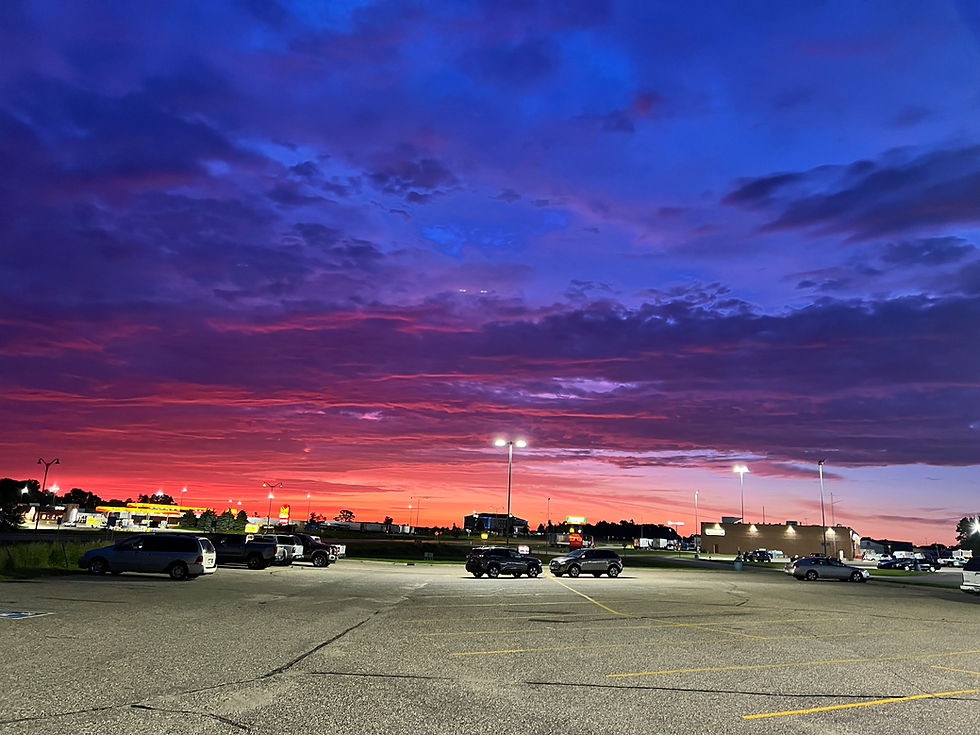
The first time I ever heard of a Safepark program was in Green Bay, Wisconsin, during the summer of 2024. I honestly cannot remember exactly how I found it, only that it was not easy.
I’m an extremely industrious person. Years of working as a case manager for senior citizens taught me how to locate resources, navigate systems, and track down assistance programs that most people never even hear about.
I used every bit of that experience to eventually uncover Green Bay’s Safepark program, which at the time was operated by the Wise Women Gathering.
That experience changed the way I thought about vehicle living in America.
For three nights, I stayed in their safe parking lot. It was clean, well-lit, and genuinely felt safe. They even fed us supper. Check-in started at 6 PM, but by 5:55 there would already be a line of cars stretching down the street, every person hoping they would make it into the lot before it filled up for the night. I was fortunate all three evenings.
Then, by 8 AM sharp, everyone had to leave.
What struck me most was not the parking lot itself, but what it represented: a society trying to solve a problem it simultaneously keeps creating.
Across America, more and more cities are passing ordinances that effectively criminalize existing while poor, mobile, or unhoused. In many places, sleeping in your vehicle is illegal. Parking overnight is restricted. Rest areas close. “No overnight parking” signs multiply across parking lots, neighborhoods, and public land.
And yet the American identity has always been deeply tied to mobility, independence, and self-reliance.
We celebrate pioneers, travelers, wanderers, road trippers, truckers, migrant workers, vanlifers, and people who “make their own way.” The open road is practically sacred in American mythology. But increasingly, local laws are sending the message that humans are only allowed to exist in approved spaces, during approved hours, under approved economic conditions.
At what point does regulation become criminalization?
At what point do we start asking ethical questions about laws that punish people simply for sleeping somewhere?
Safepark programs attempt to bridge that gap. They provide legal places for vehicle residents to park overnight without fear of harassment, tickets, or arrest. For many urban car dwellers, especially those experiencing homelessness, these lots can be life-changing.
But they also reveal another reality: there are far more vehicle dwellers than available spaces.
Most Safepark lots are small. Many have waiting lists. In Green Bay, the nightly line of cars made that obvious. Everyone was anxious about whether they would get in.
And these programs are generally designed with a specific population in mind: urban vehicle residents who identify as homeless and are seeking housing assistance or stabilization services.
That creates both advantages and disadvantages.
The advantages are obvious:
Safety
Lighting
Security
Access to food and services
Reduced police harassment
A legal place to sleep
But there are drawbacks too.
Many Safepark programs require participants to engage in case management services. The assumption is often that if you live in your vehicle, you must be homeless in the traditional sense and looking to transition back into conventional housing.
For some people, that absolutely makes sense and provides needed support.
But not everyone living in a vehicle sees themselves that way.
On my second night there, I ended up talking with a group of people in the lot and mentioned that I lived in my car by choice. They were completely baffled. They could not understand why anyone would willingly choose this lifestyle.
But people like me exist.
Some of us travel constantly. Some of us value freedom more than square footage. Some of us have intentionally stepped outside traditional housing systems for financial, emotional, philosophical, or practical reasons.
The problem is that resources for vehicle dwellers are often built around a single narrative, and the reality is much more complicated than that.
This is where organizations like the National Vehicle Residency Collective become important.
At one point, I researched and compiled a list of Safepark locations and emailed it to Dr. Graham Pruss, Executive Director of the NVRC (and a former colleague of mine). At the time I created the list, I thought building and maintaining a nationwide parking resource list might become one of my major focuses here at Road Life Hub.
Since then, I’ve realized that is not actually the direction I want RLH to go in long-term.
Today I opened the NVRC newsletter and saw that they are finally updating their Safepark list and also creating a broader parking resource database much like the one I had started putting together — though they still plan to include “spots.”
I'm happy to contribute information to their efforts because I genuinely believe the organization itself has value.
Because the need for this information is very real.
If I — someone with years of professional case management experience and a talent for finding resources — struggled to locate a Safepark program, how would the average traveler ever find one?
Especially people who move frequently.
Especially people new to vehicle living.
Especially people who do not identify as homeless and therefore do not even realize these programs might apply to them.
Safepark programs may be part of the solution for urban vehicle residents and “city nomads,” but they do not fully address the broader reality of modern vehicle dwelling in America.
And that reality is only growing.
The conflict between mobility and criminalization is not going away anytime soon.
More Americans are living in vehicles for economic reasons, personal freedom, or some combination of both. Meanwhile, cities continue tightening restrictions on where human beings are legally allowed to exist.
That tension raises uncomfortable questions:
Is sleeping illegal, or only sleeping while poor?
Why is mobility romanticized until someone does it outside conventional systems?
Who gets to decide where a human being is allowed to rest?
I do not have all the answers.
But I do know this: people living in vehicles deserve more than confusion, hostility, and legal gray areas.
They deserve information.
They deserve safety.
And they deserve the dignity of being recognized as human beings, not problems to be managed.


Comments