


When Illegal is Your Only Option
- Jul 22
- 2 min read
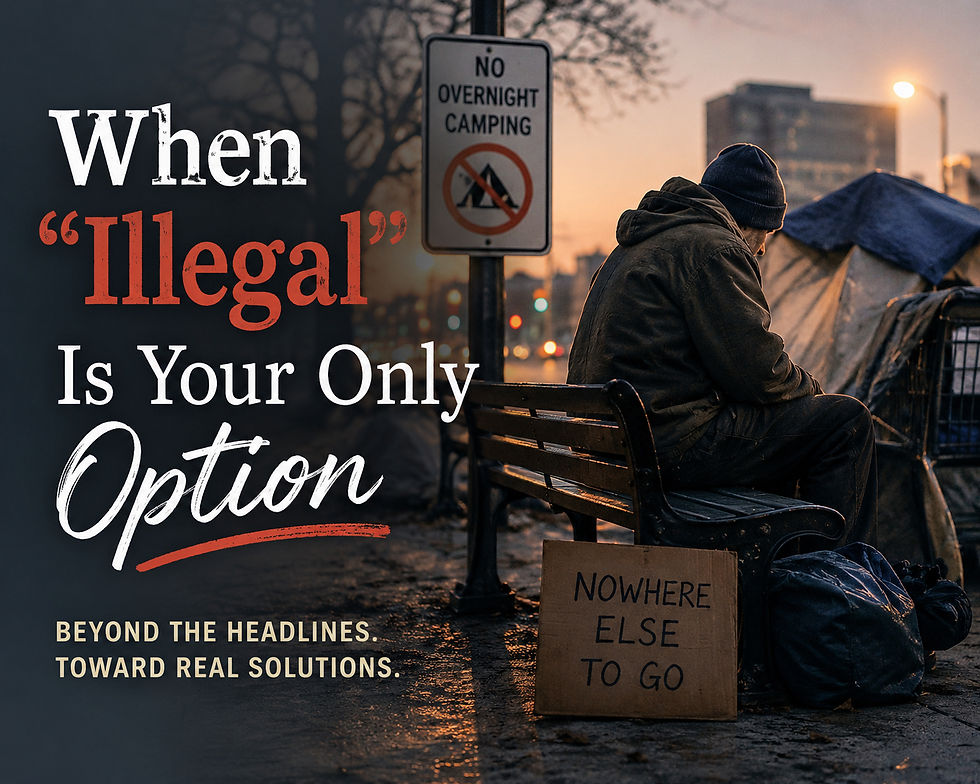
Every few weeks, another headline appears: a homeless person arrested for camping in public.
The comments usually fall into two camps.
One side says, “People shouldn’t be camping in public.” The other says, “Where else are they supposed to go?”
The uncomfortable truth is that both questions can exist at the same time.
Most communities have rules against sleeping in parks, on sidewalks, or in public spaces. Those laws exist for reasons that affect everyone. But they also create a difficult reality for someone who has no legal place to sleep.
What often gets lost in these conversations is that “homeless” isn’t one single group. Some people sleep in tents. Some sleep in shelters. Some live in RVs. Others quietly spend the night in cars or SUVs parked legally, trying not to attract attention. Many have jobs. Many are seniors. Many are dealing with disabilities or medical conditions.
When every legal option disappears, people are left choosing between breaking the law or staying awake all night.
Arresting someone for camping may solve an immediate enforcement problem, but it rarely solves the reason they were there in the first place.
Instead of asking only, “Should camping be legal?” we should also ask, “What realistic alternatives exist today?” If the answer is “none,” then we’ve created a system where survival itself becomes a violation.
Communities across the country are experimenting with alternatives: safe parking programs, managed campgrounds, sanctioned overnight lots, and partnerships between service providers and local organizations. None of these are perfect, but they recognize an important reality: people cannot solve tomorrow’s problems if they have nowhere safe to sleep tonight.
This isn’t just about enforcement. It’s about creating pathways that allow people to move forward instead of simply moving them along.
Real solutions begin when we stop seeing every person without housing as the same and start building options that meet people where they are.
Road Life Hub exists to help connect vehicle residents, service providers, and communities so that practical solutions become easier to find. We can do better than asking people to disappear.
Comments