


Essential Nomad Gear & Gadgets: Solar Panels for Life on the Road
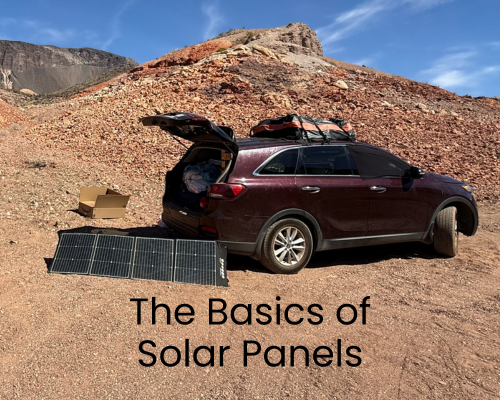
Solar sounds simple, set it in the sun, get power, but once you start using it daily, you realize the details matter. A lot. Here’s a grounded look at what actually works (and what doesn’t) when you’re living out of a vehicle.
☀️ Types of Solar Panels
1. Rigid (Flat, Permanent Mount)
Mounted directly to your roof.
Pros
Always charging when there’s sun
No setup or breakdown
Durable and long lifespan
Cons
You must park in the sun
No angle adjustment = less efficient
Installation cost and effort
Best for: Vans, buses, RVs that stay put or prioritize convenience over chasing perfect sun.
2. Portable Folding Panels
The most common for car and SUV life.
Pros
Can move into direct sun while you stay in shade
No install required
Easy to aim for better efficiency
Cons
Takes up storage space
Can blow around in wind
Setup every time
Best for: Cars, SUVs, and anyone who parks strategically (shade for you, sun for your panel).
3. Suitcase / Briefcase Panels
A sturdier version of folding panels, usually with kickstands.
Pros
More stable than multi-panel fold-outs
Often better build quality
Easier positioning
Cons
Bulkier
Still requires setup
Usually pricier per watt
Best for: People who want portable but hate flimsy gear.
4. Flexible Panels
Thin panels that can be mounted on curved surfaces.
Pros
Lightweight
Low profile
Cons
Less efficient
Shorter lifespan
Can overheat more easily
Best for: Tight or curved roof setups where rigid panels won’t fit.
⚡ Understanding Wattage (Without Overcomplicating It)
A 100W panel is a common entry point
200W–300W gives you more realistic daily usability
More wattage = faster charging, not more storage
Here’s the truth most people learn the hard way:
You will almost never get the full rated wattage.
Heat, angle, dust, and sun position all reduce output. Expect 60–80% of advertised wattage on a good day.
🔌 Plug Types, Cords & Design Details
This is where cheap gear reveals itself.
Check your connectors (MC4 is standard, but not universal)
Cord length matters more than you think
Too short = forced to park in the sun
You may need extension cables
Watch panel design
Cords should come out the back, not the front
Folding panels should feel stable, not like they’ll flap in wind
If it feels awkward during setup, it’ll get annoying fast.
🌬️ Wind, Stability & Real-World Fixes
Portable panels and wind do not get along.
Simple fix:
Put rocks or boards on the kickstand legs
The stronger the wind, the heavier the weight
Without that, your panel will shift, and every shift kills efficiency.
📐 Positioning Your Panel (This Matters More Than Wattage)
Here’s a trick that actually works:
Look at the shadow behind your panel. When the shadow is perfectly square with the panel, you’re aligned with the sun.
As soon as the shadow shifts, your efficiency drops. Reposition.
Also think about:
Trees
Buildings
Hills
Your parking direction
A 200W panel in partial shade can perform worse than a 100W panel in full sun.
🔥 Heat & Safety
The connection point between your panel and power station can get very hot.
Check it regularly
Keep it out of direct sun if possible
Don’t bury it under fabric or gear
Heat buildup here is one of the more overlooked fire risks.
🔋 A Quick Note on Power Stations
Don’t confuse these two numbers:
Solar panel wattage = how fast you generate power
Power station capacity (Wh) = how much you can store
They are related, but not interchangeable.
(We’ll get into choosing power stations another time.)
🚗 What Works Best by Lifestyle
Car living: 100W–200W portable panel
SUV setups: 200W portable or small roof + portable combo
Van life: Roof-mounted + optional portable for flexibility
Bus/RV: Larger fixed systems, sometimes with portable backup
The more space you have, the more you benefit from permanent setups, but portability gives you control.
📦 Storage Tips
Store panels flat and protected (not wedged where they flex)
Avoid stacking heavy gear on top
Keep connectors clean and dry
For folding panels: don’t force hinges. This is a common failure point
Final Thought
Solar isn’t about buying the biggest panel, it’s about how you use it.
Positioning, stability, and setup habits will make a bigger difference than upgrading from 100W to 200W.
If your panel isn’t performing well, don’t assume you need more gear.
Fix the fundamentals first.


Comments