


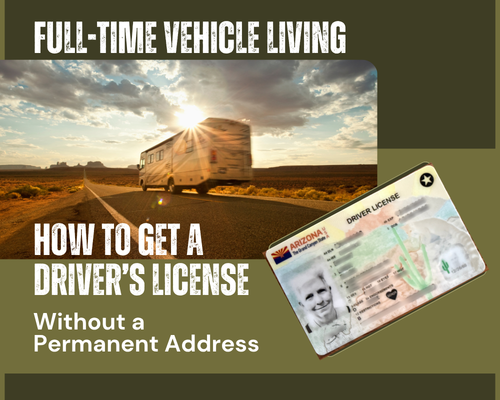
Vehicle Living: How to Get a Driver's License Without a Permanent Address
Every state asks the same question at the DMV, and it's one a full-time vehicle dweller can't answer the way the form expects. They want a residential address, somewhere you sleep, somewhere mail can land. For most nomads, that address doesn't exist.
Your home moves, and none of that fits in the box on the form.
This isn't a new problem, and there are real ways through it. But most of the advice out there treats it like a simple checklist, when it actually depends on your situation, the state you're dealing with, and how much risk you're willing to take. I want to walk through what works, what's changed recently, and the one option almost nobody talks about.
The Basic Requirement You're Up Against
Most states now require REAL ID compliance, which means two documents proving your residential address, issued within the last year, from two separate sources. A utility bill and a bank statement, for example. The catch is that most of these documents can't be tied to a P.O. box or a commercial mailbox service.
The system assumes you have a fixed address where bills arrive. If you don't, you're starting from a deficit before you even reach the counter.
This is where a lot of nomads turn to mail forwarding services in states built around this exact problem. Texas, Florida, and South Dakota come up constantly in nomad communities. You sign up for a service that gives you a physical address, and that becomes your address for everything:
Driver's license
Vehicle registration
Insurance
Taxes
Voting
South Dakota in particular has been a long-standing favorite because the process used to be incredibly simple. You'd spend one night in the state, get a receipt, sign an affidavit saying you intend to return someday, and walk out with a license. That part is technically still in place.
But South Dakota passed laws in 2025 that cracked down on full-time travelers using business addresses, like campgrounds, to register to vote. The license process itself didn't change much, but the broader picture of being a South Dakota resident, especially around voting, got more complicated. If you're considering South Dakota, check the current rules before committing, because a blog post from a few years ago may not reflect where things stand now.
If You Have a Friend Willing to Help
This is the option that worked for me, and I'll be upfront that I got lucky. I live with someone whose home is a park model in an RV resort in Arizona, meaning it's a permanent, non-moving structure. That makes it a legitimate residential address, and he was willing to let me use it. At the DMV, I needed two pieces of mail with my name on it at that address, and that was easy to produce.
Before that, my domicile was Vermont, but I didn't actually have an address there. I had old friends I could technically use, though by then I'd mostly cut ties with that part of my life. It worked, but it left me in a strange position.
My Vermont inspection sticker expired, and I couldn't get a new one. The seatbelt light on my dash was on because I'd removed my passenger seat to make room for a refrigerator. A shop in Vermont told me I either needed to put the seat back in or drive without a valid sticker. I chose the second option and worried about it every time I passed a police car.
I never got pulled over for it. I did get "the knock" from an officer in California who wanted to know why I had Vermont plates, but he never even looked at the inspection sticker.
The point isn't that a friend's address solves everything. It's that holding domicile in a state you're nowhere near creates its own problems. You can't keep your car compliant with that state's requirements if you're never there. The address gets you in the door, but it doesn't make the rest of the system make sense.
And if you don't have a friend or family member willing to help, this option simply isn't available. The system assumes everyone has someone like this, and a lot of people don't.
The Option Many Don't Know About
When I visited a homeless shelter in Tucson, I learned something that surprised me. The shelter had a post office on site, and people experiencing homelessness could use that address as their permanent address, both for receiving mail and for establishing domicile.
This isn't unique to that one shelter. Several states have written it into law:
Florida allows people who are homeless, staying in a shelter, or receiving services from a transitional provider to apply for a license without a permanent address.
New Hampshire lets someone without a permanent address use the address of a qualified social service organization, as long as that organization provides a letter authorizing it.
I want to be careful here, because "go to a homeless shelter" isn't advice anyone wants to hear. For a lot of nomads, there's a layer of pride or denial that gets in the way of even considering it.
But the reality is that many full-time vehicle dwellers are, by definition, without a permanent address, and these provisions exist for exactly that situation. This is a legitimate, legal path, not a loophole. It's worth calling a shelter near you and asking whether they offer it, even if you have no other connection to their services.
The Healthcare Piece Nobody Warns You About
This part matters most for older nomads, and it's one of the more frustrating consequences of the address problem. If you're on Medicaid, your coverage is tied to the state that issued it. Most providers won't accept an out-of-state Medicaid card, so if you're traveling and need urgent care, you may end up paying out of pocket even though you have insurance.
Telehealth makes this worse in a way that catches people off guard. Doctors are licensed state by state, and in many states, a Medicaid telehealth visit requires both the provider and the patient to be physically in that state at the time of the appointment. So if your doctor is in Texas and you're parked in Oregon when your appointment comes up, that visit may not be covered, even if it's the same doctor you've seen for years.
Medicare works a little differently. Original Medicare is national and doesn't have this service-area problem. But Medicare Advantage and Part D plans are tied to a specific service area, and you generally need to be in that area for at least half the year to stay eligible. If your travel takes you outside that area for long stretches, you could lose coverage and have to re-enroll in a new plan.
For someone managing a chronic condition, this isn't a minor inconvenience. It can mean starting over with a new doctor every time you cross a state line, or going without care until you're back in range.
Where This Leaves You
There isn't one answer here, and I think that's the honest takeaway. The path that fits depends on what you have available:
A friend or family member's address is the simplest, but it comes with complications if you end up far from that state.
A mail forwarding service in a nomad-friendly state is the next option, with the understanding that the rules can and do change.
A homeless shelter or social service address is real, legal, and more available than most people realize.
What ties all of this together is that the system wasn't built with people like us in mind. Every workaround is a patch on a form that assumes you have a house. That isn't going to change soon, so for now, the best any of us can do is know which patches exist and which one fits the life we're actually living.


Comments